

Before that, one thing all those formal definitions either forget to mention or don’t have room to mention is the fact that Autism is a spectrum condition which, to put it simply, means different people are affected by it in different ways. There is a common saying in Autism Circles that if you’ve met one autistic person, you’ve met one autistic person. The spectrum is currently recognised as having three levels to it that I’ve illustrated with multiple-coloured blocks below.
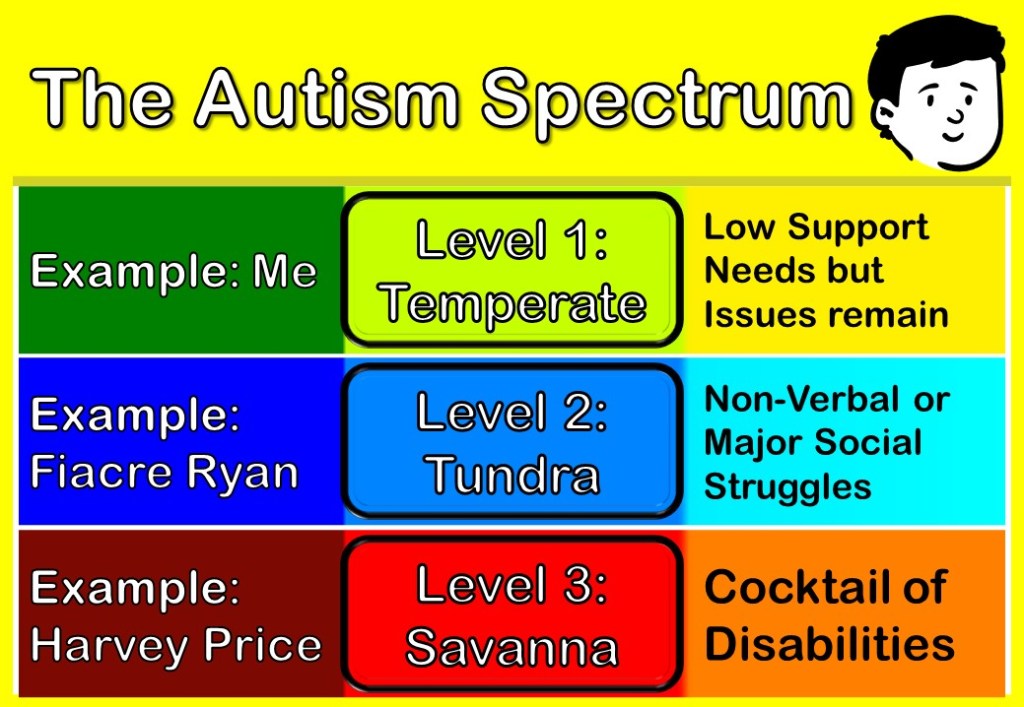
You may be wondering why I have placed random climate terms below each level. Well, that’s because I think each level is like a different type of climate that, unlike our real one, generally does not fundamentally change without supports that would never be endorsed by Autism Speaks.
For Level 1, I have chosen Temperate, type C on the contentious Köppen Classification and between 25° and 70° North and South of the Equator [7]. Why? Well, Temperate is like Ireland’s weather, four seasons in one day, at least right now. Support needs are generally lower than the other two levels but the reason I have Yellow in that block is because there are times when a meltdown can’t be helped, and supports are essential to completing certain tasks and gaining certain experiences. I consider myself a walking example of this level and as already mentioned, I’ll give a general overview of how in the next post.
For Level 2, I chose Tundra, climate classification E, 60° and higher above and below the equator [7]. The reason I’ve done that is because I view most non-verbal autistic people as having a speech and language department in their brain that is frozen but capable of being thawed out with, again, the right supports that would probably be overlooked by Autism Speaks. I would also include people who really struggle with sustained socialisation or who tend to go mute when their Fire Shape (more on that next week) is triggered, which the Aqua part of that block represents.

The example I use for this level is Fiacre Ryan. I first became aware of him through an RTÉ Documentary, Autism and Me [8], which was originally broadcast in 2017, and I think is a perfect example of how the Spectrum could be explained cinematically. Fiacre is non-verbal and only communicates through something called the Rapid Prompting Method. RPM, as demonstrated by him, is using a board of letters and numbers to spell out words and sentences, one letter at a time, mere seconds after each one. A voice actor speaks out Fiacre’s complete sentences and gives a sample of some poetry he has subsequently released as part of various collections.
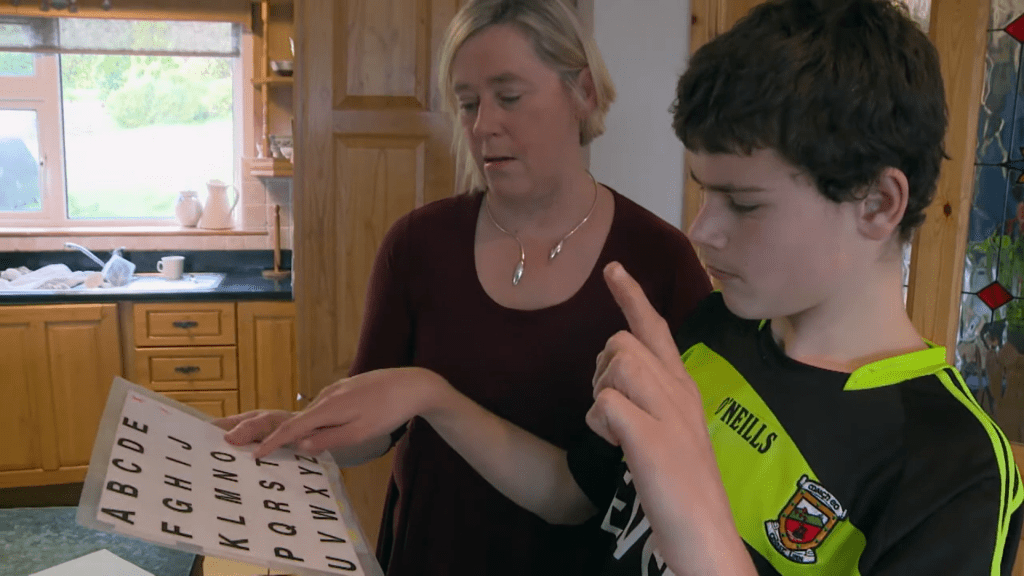
At the time the documentary was filmed, Fiacre’s family were trying to have RPM included as an aid for him ahead of his Leaving Certificate in two years’ time. I’m not sure how far they managed to get on that journey but suffice to say, it’s not really a technique generally recognised as a good idea by everyone… For example, the American Speech-Language-Hearing Association released a Position Statement [9] in 2018 recommending against RPM. They cited a fear of patients developing prompt dependency, a lack of thorough scientific scrutiny of the technique, and the risk of some assuming RPM is the only communication method of some disabled people in general. I’m not best-placed to comment on whether I think those concerns are warranted or not, so click here to read the entire statement and judge for yourself.

 The ADog Blog
Adam, your blog will soon be added to our Actually Autistic Blogs List (https://anautismobserver.wordpress.com/). Please click here (or on the “How do you want your blog listed?” link at the top of that site) to customize your blog’s description on the list (or to decline).
Thank you.
Judy (An Autism Observer)
LikeLike